Archive Search
Advanced Options
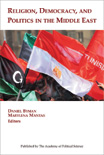
2012 · 250 pages
ISBN13: 978-1-884853-09-8
ISBN10: 1-884853-09-9
Paperback: $27.50 (APS Members: $22.00)
| Order: | Paperback |
“This is indeed a historic period,” writes John Esposito of the immediate post-Arab Spring era in the chapter he contributed to this book. Collectively, the articles in Religion, Democracy, and Politics in the Middle East speak to this period by explaining many of the most important issues in the region today in a way that is historically and theoretically informed.
Divided into three sections, this book offers scholarly analysis not only of current developments, but also of critical historical episodes and their ramification on the region. It also discusses the future of the Middle East, including its relations with the United States and the role of political Islam.
Taken together, these chapters advance our understanding of this important region at a time of great change. They form a rich trove that will leave the reader better aware of the nuance and complexity behind the newspaper headlines.
Publisher's Foreword
Demetrios James Caraley
Overview: A New Middle East?
Daniel Byman
PART I: HISTORICAL LESSONS
Dysfunction Doctrines? Eisenhower, Carter, and U.S.Military Intervention in the Middle East
Jeffrey H. Michaels
Camp David Rashomon: Contested Interpretations of the Israel/Palestine Peace Process
Myron J. Aronoff
PART II: CURRENT ISSUES
Regime Change in the Middle East: Problems and Prospects
Daniel Byman
Ideological Change and Israel’s Disengagement from Gaza
Jonathan Rynhold and Dov Waxman
The Rationality of Radical Islam
Quintan Wiktorowicz and Karl Kaltenthaler
The Demise of the PLO: Neither Diaspora nor Statehood
Hillel Frisch
PART III: LOOKING FORWARD
The Future of Islam and U.S.-Muslim Relations
John L. Esposito
The Paradox of Islam’s Future
Raymond W. Baker
Join the Academy of Political Science and automatically receive Political Science Quarterly.
America at a Crossroads: The 2024 Presidential Election and Its Global Impact
April 24, 2024
8:30 a.m. – 12:00 p.m. ET
New York, NY
Virtual Issue
Introduction: Black Power and the Civil Rights Agendas of Charles V. Hamilton
Marylena Mantas and Robert Y. Shapiro
Publishing since 1886, PSQ is the most widely read and accessible scholarly journal with distinguished contributors such as: Lisa Anderson, Robert A. Dahl, Samuel P. Huntington, Robert Jervis, Joseph S. Nye, Jr., Theda Skocpol, Woodrow Wilson
view additional issuesArticles | Book reviews
 |
CHINA IN A WORLD OF GREAT POWER COMPETITION |
The Academy of Political Science, promotes objective, scholarly analyses of political, social, and economic issues. Through its conferences and publications APS provides analysis and insight into both domestic and foreign policy issues.
With neither an ideological nor a partisan bias, PSQ looks at facts and analyzes data objectively to help readers understand what is really going on in national and world affairs.


