The Journal of Public and International Affairs
Published since 1886 by the Academy of Political Science
Archive Search
Advanced Options
pp. 874-876
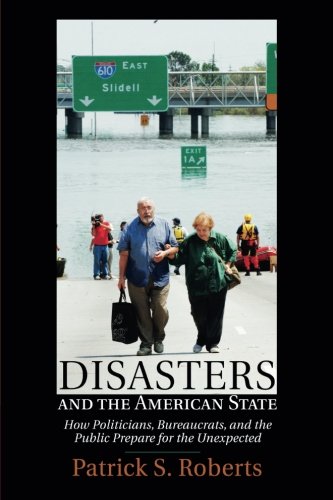
Disasters and the American State: How Politicians, Bureaucrats, and the Public Prepare for the Unexpected, Patrick S. Roberts
This book develops three intertwining themes about the development of what Patrick S. Roberts calls the “disaster state.” The first theme traces the expansion of federal disaster response as it has evolved from ad hoc relief funding prior to the New Deal to our contemporary president-centered and bureaucratized response system. The second theme explores the uneasy coexistence of two missions for the disaster state—civil defense or homeland security on the one hand and natural disaster response on the other. The third theme examines the tortured rise of the Federal Emergency Management Agency (FEMA) and how it functions in a politicized federal system. Roberts’ social constructivist perspective ties the three themes together, offering a unique historical perspective on the rise of the disaster state.
The book begins with a description of the federal response to the 1927 Mississippi floods, an important episode in the transition from a Congress-centered to a president-centered disaster system. In response to that massive flood, President Calvin Coolidge appointed Commerce Secretary Herbert Hoover to serve as the federal response czar. State and local governments welcomed the aid, and Hoover’s success later propelled him to the presidency. Roberts contrasts this outcome with the far less successful response to Hurricane Katrina nearly
To continue reading, see options above.
Join the Academy of Political Science and automatically receive Political Science Quarterly.
APS Forum | Book Talk - The Insiders' Game: How Elites Make War and Peace
June 22, 2026
WEBINAR
CONTRIBUTIONS TO POLITICAL SCIENCE
Governing by Decree: The Trump Presidency and the Decline of “Legislating Together”
Desmond King
Publishing since 1886, PSQ is the most widely read and accessible scholarly journal with distinguished contributors such as: Lisa Anderson, Robert A. Dahl, Samuel P. Huntington, Robert Jervis, Joseph S. Nye, Jr., Theda Skocpol, Woodrow Wilson
view additional issuesArticles | Book reviews
 |
AMERICA AT 250:
AT HOME AND BEYOND |
The Academy of Political Science, promotes objective, scholarly analyses of political, social, and economic issues. Through its conferences and publications APS provides analysis and insight into both domestic and foreign policy issues.
With neither an ideological nor a partisan bias, PSQ looks at facts and analyzes data objectively to help readers understand what is really going on in national and world affairs.