The Journal of Public and International Affairs
Published since 1886 by the Academy of Political Science
Archive Search
Advanced Options
pp. 837-838
UN Mediators in Syria: The Challenges and Responsibilities of Conflict Resolution, Fadi Nicholas Nassar
“What do UN mediators actually do in conflicts like the one in Syria?”. This is the question that Fadi Nicholas Nassar seeks to answer in UN Mediators, his important analysis of three United Nations (UN) mediators in Syria: Kofi Annan (February 2012–August 2012), Lakhdar Brahimi (August 2012–May 2014), and Staffan de Mistura (July 2014–October 2018). Whereas existing research has emphasized contextual factors (e.g., the “ripeness” of the conflict for settlement or the strength of rebel groups) and individual-level variables (e.g., the dominant mediation style of the mediator) for explaining mediation success or failure, this book offers an in-depth understanding of why mediators design mediation the way they do. Specifically, this book generates case-specific insights and more general hypotheses regarding why mediators (1) prioritize the interests of local stakeholders to the conflict over the interests of regional players or major powers, (2), engage in a small number rather than many public mediation initiatives, and (3) get stakeholders to agree with positions that do not align with their initial interests.
To do so, the book combines process-tracing of key steps in the mediation process in Syria with “first-level analysis” assessing patterns of perceptions and evaluations of the three mediators in the 20
To continue reading, see options above.
Join the Academy of Political Science and automatically receive Political Science Quarterly.
Academy Forum | The 2024 Presidential and Congressional Elections: Small Wave, Seismic Effects
WEBINAR
Jimmy Carter's Legacy
Jimmy Carter's Public Policy Ex-Presidency
John Whiteclay Chambers II
Publishing since 1886, PSQ is the most widely read and accessible scholarly journal with distinguished contributors such as: Lisa Anderson, Robert A. Dahl, Samuel P. Huntington, Robert Jervis, Joseph S. Nye, Jr., Theda Skocpol, Woodrow Wilson
view additional issuesArticles | Book reviews
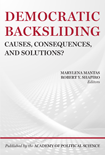 |
DEMOCRATIC BACKSLIDING:
CAUSES, CONSEQUENCES, AND SOLUTIONS? |
The Academy of Political Science, promotes objective, scholarly analyses of political, social, and economic issues. Through its conferences and publications APS provides analysis and insight into both domestic and foreign policy issues.
With neither an ideological nor a partisan bias, PSQ looks at facts and analyzes data objectively to help readers understand what is really going on in national and world affairs.


